For Darkness Shows the Stars by Diana Peterfreund
Part dystopian future, part teenage love story, part philosophical debate on whether a man's reach should or should not exceed his grasp and what either might mean to the larger community of mankind (but don't let that scare you), told through a clever replotting of Jane Austen's Persuasion.
Well into a post-apocalyptic future Earth history, Luddite Elliot refuses to run away with Post Kai, choosing to sacrifice her own happiness to ensure the survival of the Reduced workers on her family estate. Four years later Kai returns triumphant, rich and successful beyond their wildest youthful dreams. Elliot still loves him, he appears to hate her, and his intelligent, able Post companions only emphasize the differences between his life and hers, spent everlastingly cleaning up after her spoiled sister, her cruel father and her wicked cousin.
Horror and Jane don't pass the smell test for me, but science fiction and Jane sure did. I especially enjoyed that Anne -- sorry, Elliot -- got to have a job and to do it well.
Note: My book club is going to be reading and discussing this book together with Austen's Persuasion later this year.
# Permanent link to Part dystopian future, part teenage love story, all Jane Austen
...that any book you truly love is in need of a properly annotated edition.
# Permanent link to It is a truth universally acknowledged…
Go here to read the full story.
# Permanent link to Pack Horse Librarians


Between Shades of Gray by Ruta Sepetys
Reading a book like this makes you ashamed of every time you ever whined about anything.
Fifteen-year old Lina, her mother, and her little brother Jonas, along with hundreds of thousands of other Lithuanians and Latvians and Estonians and Finns, are yanked out of their homes in Lithuania by Stalin's NKVD in 1941. They are thrown on trains that take them out of Europe and into Asia, where they are forced to work as slave labor, first in a Siberian beet field and then in a Siberian fishing village on the edge of the Arctic Ocean. After the few things they managed to take with them are sold they steal beets from the fields and eat scraps out of the guards' garbage. When they are moved to Trofimovsk under the even more sadistic Captain Ivanov, even those options are gone.
Stalin was engaged in ethnic cleansing of the most sweeping kind. Hitler wasn't the only monster loose in Europe during World War II.
Lina says
I hated them, the NKVD and the Soviets. I planted a seed of hatred in my heart. I swore it would grow to be a massive tree whose roots would strangle them all.
In the afterword, Sepetys writes
...most Baltic people harbor no grudge, resentment or ill will. They are grateful to the Soviets who showed compassion.
Yeah, big whoop for Dr. Samodurov, and guard Nikolai Kretzsky, who was in fact half Finnish himself, two kind men out of all the NKVD brute bastards who abused and beat and starved and murdered them long past the ending of the war.
Some wars are about bombing, Sepetys writes. For the people of the Baltics, this war was about believing. In 1991, after fifty years of brutal occupation, the three Baltic Countries regained their independence, peacefully and with dignity. They chose hope over hate and showed the world that even through the darkest night, there is light...These three tiny nations have taught us that love is the most powerful army. Whether love of friend, love of country, love of God, or even love of enemy--love reveals to us the truly miraculous nature of the human spirit."
Pretty to think so, and there is, amazingly, laughter and love herein, but the only thing that really kept Lina (and me) going was the aforementioned tree of hatred.
This isn't an easy read but I tore through it in an evening anyway. It's a chapter of human history I knew very little of, and it reminded me yet again that fiction is a marginally easier way into stories like these, whose virtue is to bear witness, lest we forget. But when I do read these books, like The Poisonwood Bible (the Congo) and Birds Without Wings (Turkey), I wonder just how far The Hunger Games is from us all.
Click here to read all my Goodreads reviews.
# Permanent link to To bear witness, lest we forget.
My Life in France by Julia Child
I spent the summer of 1987 in Paris, studying beginning French at the Sorbonne and staying at the Cité Universitaire, in a program geared toward older students. Some of them wanted to take a cooking class, and the Sorbonne organized it for them. They needed one more student to make it go, and I was browbeaten into filling the empty space.
Understand, I was raised on the five Alaskan staples of Spam, Bisquik, Velveeta, pilot bread and Carnation Instant Milk. If we didn't get our moose that year we didn't eat meat, except on my birthday, when I got pork chops no matter what. We got all the salmon and king crab we could eat for free. The salmon was mostly fried. The crab was mostly boiled. The first fresh milk I ever drank was in college. The first real cheese, same. Remember those Kraft Cracker Barrel packages of four logs of four different kinds? Until then I thought I hated cheese.
So at the time I went to this cooking school, my most complicated prepared meal was a hamburger. Claudine, our chef, went around the class, asking where we were from, and when I said Alaska her eyes lit up. "Alaska," she said, "sauvage..." and made up a roux for wild game on the spot just for me.
I've been playing catchup in the kitchen ever since. I can't believe it's taken me this long to discover Julia Child.
This book is the story of her life in France, from the first oyster in Rouen to the last pot roast at La Pitchoune in Provence. It's a love story, of her marriage with Paul Child, who is about the most intelligent, charming man I've ever met between the covers of a book. It's a voyage of discovery into French cuisine, into the science of cooking, into collaborating on and writing a cookbook, or any book for that matter. And it's a mesmerizing walk through Paris looking over Julia's shoulder. The first year she says
By now I knew that French food was it for me. I couldn't get over how absolutely delicious it was. Yet my friends, both French and American, considered me some kind of a nut: cooking was far from being a middle-class hobby, and they did not understand how I could possibly enjoy doing all the shopping and cooking and serving by myself. Well, I did! And Paul encouraged me to ignore them and pursue my passion.
(You'll remember what I said about Paul being intelligent and charming.)
The how-to portion of this book is fascinating. French ingredients are different from American ingredients and the French learn cooking by watching, not reading recipes, so Julia would take the recipes of her French collaborators and translate them and the ingredients and the measurements of the ingredients into something an American cook could, first, buy the ingredients for in America, and second, understand and recreate. And then she'd test them and test them and test them and test them again, and she and Paul would eat them and eat them and eat them and eat them again until it was foolproof enough to unleash upon American cooks. "No one is born a great cook," she says, "one learns by doing."
In between they'd drive around France and eat in great restaurants. In a more perfect world I would have been their child.
She concludes with a remembrance of that first, marvelous meal in Rouen
...the sole meuniere I ate at La Couronne on my first day in France, in November 1948. It was an epiphany.
In all the years since that succulent meal, I have yet to lose the feelings of wonder and excitement that it inspired in me. I can still almost taste it. And thinking back on it now reminds me that the pleasures of the table, and of life, are infinite -- toujours bon appetit!"
I gotta say, I got a little teary at the end of this book. And I just ordered my first ever copy of Mastering the Art of French Cooking. Both volumes.
Click here to read all my Goodreads reviews.
[youtube http://www.youtube.com/watch?v=80ZrUI7RNfI?list=PL26EE48981A093CA0&hl=en_US&w=640&h=360]
# Permanent link to Bon appetit!
[from the Stabenow.com archives, January 25, 2010]
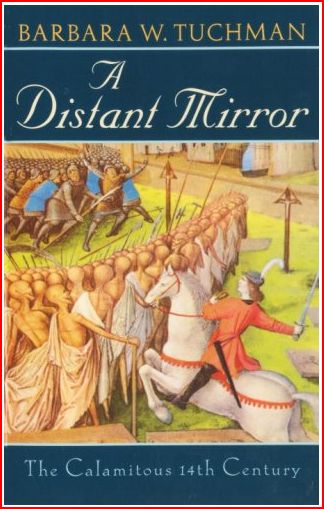
It’s not often you find a good historian occupying the same body as a good writer -- think of any history text you were force-fed in high school -- but Barbara Tuchman was a stellar exception. I’m still mad at her for dying before she wrote more books. Try a A Distant Mirror, a look at the effect on society of the Black Death of 1348-1350, which killed a third of the population between India and Iceland. In the foreward, Tuchman describes this time as a “violent, tormented, bewildered, suffering and disentegrating age, a time, as many thought, of Satan triumphant.”
Sound familiar? The more things change.
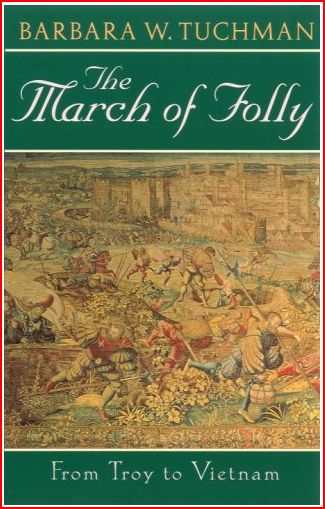
My favorite Tuchman book is The March of Folly. With the almost parental exasperation that characterizes so much of her writing, Tuchman posits the existance of folly, which she defines as the pursuit of public policy contrary to self-interest. To qualify for the definition of folly, Tuchman writes, the policy must meet three criteria. One, it must have been perceived as being wrong in its own time. Two, a feasible alternative course of action must have been available. And three, the policy had to have been that of a group, not an individual, and had to persist beyond one lifetime.
Her template is the Trojans taking the Greek horse inside the city walls. Next, the Renaissance popes provoke the Reformation by selling indulgences, elevating illiterate drunks to the pulpit and hosting orgies in the Vatican. The third folly is the British losing America, in which Dr. Samuel Johnson is memorably quoted as saying that Americans were “a race of convicts and ought to be grateful for anything we allow them short of hanging.”
Hard to believe we rebelled, isn’t it?
The fourth folly, and I think the one that inspired Tuchman’s conception of folly and the writing of this book, is America in Vietnam.
And then, if you want to understand the beginnings of America in Vietnam, read Tuchman’s Stilwell and the American Experience in China, in which you learn that Americans screwing up in Southeast Asia wasn't exactly a new experience.A delightfully acerbic prose style, sort of on the order of “Lord, what fools these mortals be!”, combined with an exhaustive but nonetheless easily accessible scholarship and a you-are-there sense of time and place, the Tuchman historical oeuvre makes for seriously good reading, and you'll learn a thing or two along the way.
# Permanent link to Barbara Tuchman

Lunch in Paris: A Love Story, with Recipes by Elizabeth Bard
An American woman falls in love with a Frenchman and moves to Paris. Some great recipes (the chocolate souffle is really easy and pretty tasty, and I'm trying the tagine at the first opportunity) and some interesting observations on French life from an American perspective, as in:
She wonders how her soon-to-be mother-in-law stays so slim. Answer: The French eat at the table, not on the couch, they don't snack, they cook just enough for one serving per person, and they don't go back for seconds even if there are leftovers.
Her fiance is reluctant to pursue a career in film because they just don't do things that way in France. "You will never understand," says Gwendal [the fiance]. "You come from a place where everything is possible." Later, he adds, If you want to do something different, if your head sticks up just a little, they cut it off. It's been like that since the Revolution. You know the saying, Liberte, egalite, fraternite. Egalite, equality, is right in the middle. Everyone has got to be the same."
Encouraged by Bard, he goes to LA and takes meetings and comes home full of enthusiasm, which he then shares over dinner with a French couple. Who are startled and alarmed at his presumption, and whom they never see socially again.
On her mother's attempt to buy a pate pan in which to make cheesecake. In the States, a salesperson would sell you his left foot if you wanted it, and probably gift-wrap it to boot, writes Bard, but the French salesman says, "This is for pate, madame, not gateau...Why do you want to buy somesing when you do not know what it is for?"...In France, the customer isn't always right. On the contrary, the customer is often deeply wrong, and the person behind the counter will not hesitate to tell you so.
There is an eye-opening passage on living through 9/11 overseas, too.
# Permanent link to “If your head sticks up just a little, they cut it off.”
As Texas Goes...: How the Lone Star State Hijacked the American Agenda by Gail Collins
As Texas goes, says Collins, so goes the nation, and there are some revelatory and I must admit pretty horrifying details about how the state of Texas has led the way in banking laws, education (especially sex education, or embargo of), textbooks, global warming, immigration and voters' rights, written with that lighthearted acerbity we enjoy so much in her NYT opinion column. In the prologue she writes
Texas banking laws set the stage for the savings and loan crisis in the 1980s. The 2008 economic meltdown was the product of a financial deregulation that was the work of/Texas senator Phil Gramm. Our energy policy is the way it is in large part because Texas politicians and Texas special interests like it that way...Schools from Portland, Oregon to Portland, Maine, have been remade, reorganized, and sometimes totally upended under a federal law based on Texas education reform. For several generations, our kids have been reading textbooks written with an eye to Texas sensibilities. Texas presidents have the led the country into every land war the United States has been involved in since Vietnam.
This wasn't really a book, it was a 200-page column with a bunch of appendices supporting her points. I wonder if she wasn't perhaps rushing to print before her premise became dated, because I found at least two gaping holes in her logic.
1. She doesn't talk near enough about the Hispanic population of Texas, which in number is rapidly overtaking the Anglo population of Texas. Anglo Texans are largely Republican. Hispanic Texans are largely Democrat. Texas is on the brink of going blue in a big way. I wish she'd spent more time with guys like San Antonio mayor Julian Castro. There is the future of Texas.
2. She also makes no reference to e-books, which is on its own cusp, that of revolutionizing textbooks. I speak from personal experience here: Changing the text of an ebook is so easy compared to changing the text of a print book. So what if Texas wants to axe the New Deal or evolution or global warming or separation of church and state out of its textbooks? Let 'em. In ebooks, the rest of the states can add all those subjects right back in with relatively few labor costs. And there is the future of textbooks.
This is a book worth reading, but it might have been more accurate to have called it "As Texas Went."
# Permanent link to As Texas Went
Click here to read all my Goodreads reviews
The great thing about going to book conferences is that there you are, penned up with a bunch of other people who all love books. This time it was the Poisoned Pen Con in Phoenix, a small, intimate gathering with single-track paneling where you have time to visit with other readers and hobnob with your favorite authors.
One of my favorite authors is Francine Matthews (aka Stephanie Barron) and she and I and Barbara Peters were talking about our favorite Golden Age mysteries. They were as one in declaring The Tiger in the Smoke to be one of their favorites.
I'd read a couple of the Albert Campion novels way back when, didn't like them much and moved on, but if Francine and Barbara say it it must be so, I picked up a copy.
London, 1950. Beautiful couturier Meg Elginbrodde lost her husband in World War II and after mourning him for five years has become engaged to Geoffrey Levett. Unfortunately, as soon as they announce their wedding photos of her previously deceased husband begin appearing in the society journals, and she calls in Campion for help.
There is some lovely description here, especially of the oppressive London fog, "a saffron blanket soaked in ice-water" and "[the fog] oozed in ungenially, to smear sooty fingers over the two elegant young people who sat inside" and "greasy drapery." Yeesh.
But what I love most about this book is the character descriptions. Take Campion's associate, Divisional Detective Chief Inspector Charles Luke:
Charlie Luke in his spiv civilians looked at best like a heavyweight champion in training...His pile-driver personality...It made him an alarming enemy for someone.
When he is detailing a subordinate to accompany an unwilling Canon Avril, Luke says, "He's my senior assistant, a quiet, discreet sort of man," he added firmly, eying the sergeant with open menace." You'd develop quiet discretion, too, if Luke looked at you that way.
Of Canon Avril, Meg's father, Allingham writes:
He believed in miracles and frequently observed them, and nothing astonished him. His imagination was as wild as a small boy's and his faith ultimate. In ordinary life he was, quite frankly, hardly safe out.
(As is made manifestly obvious when he nearly gets his daughter killed, for which Allingham never brings him to judgement, the only thing that irritates me here.)
There are lots of fun throwaway lines and phrases everywhere. Of one of the minor characters Allingham writes, "Her voice was gentle, placatory, and never-ending." At one point Levett says, "Values are so relative...Hitler wanted the modern world. Well, I mean to say, Campion, look at the modern world!"
Francine and Barbara recommended the next two books in the Campion series, too, The Beckoning Lady, which I've already started, and Hide My Eyes, which is on my to-read shelf.
# Permanent link to Time Traveling Back to the Golden Age of Detective Fiction

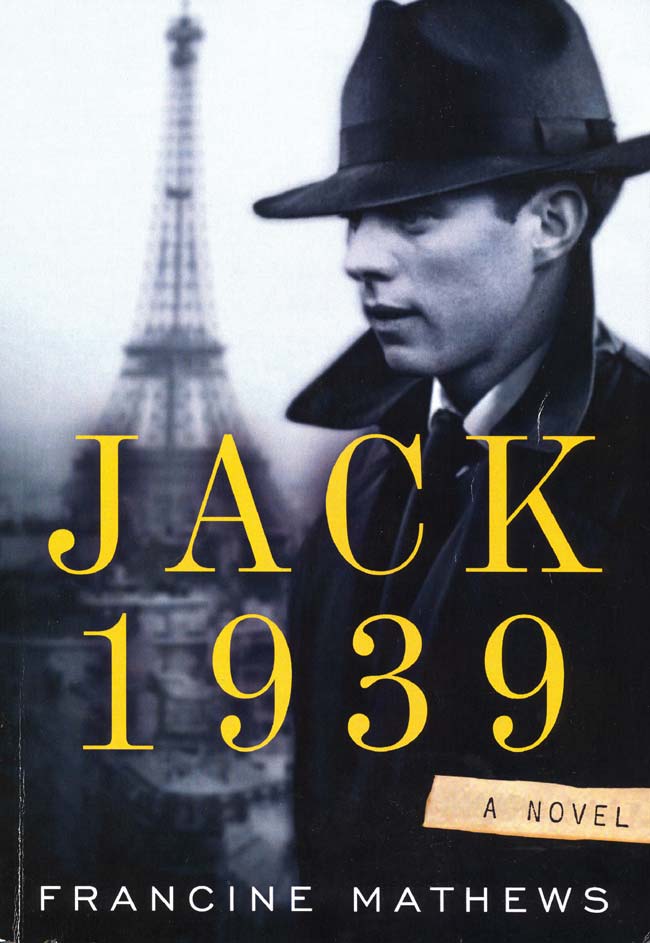
What if FDR sent a twenty-one year old JFK to Europe on the very eve of World War II itself in order to find out if and how Hitler was smuggling money into the US to influence the next election?
"I've been turning it over in my mind, Jack--this trip of yours," the President was saying. "To the Nazis, you're just the American ambassador's son. But to me, you're a perfect spy. My independent thinker. Arriving in London with a fresh outlook and an unclouded mind. As far as the Nazis are concerned, you're clean as the driven snow. They know your dad and I don't always agree. They'll never expect you to be my man in Europe."
Jack, who is as ill with some undiagnosable disease as he can be and not be dead, finds this proposal flattering and irresistible. If he's going to die at any moment any way, why not die being FDR's man in Europe?
So in Jack 1939 he boards the Queen Mary for England and nearly all the European capitals, closely pursued by the White Spider, a Nazi SS agent who is very quick with a very sharp knife, closely cultivated by German intelligence agent Willi Dobler, and intensely damned by every American ambassador in every European capital for the trouble he causes them, not excluding his own father. There is a beautiful older woman, Diana Playfair, another amateur spy with whom Jack has a passionate affair, whose ending will break your heart as painfully as it breaks Jack's.
One of the most enjoyable things in this book are all the walk-on parts by real people, beginning with Jack's family (Joes Sr. and Jr. don't come off all that well, and Rose, my god, Jack would have been better off with Dracula's bride as his mother) and including just about everyone else in the World War II Almanac.
Oh yes, J. Edgar Hoover is here, too, and up to his usual Machiavellian shennanigans. Fear not, FDR's got his number, and unbeknownst to Hoover, he's got Jack, too. A fun read.
# Permanent link to JFK, Spy