
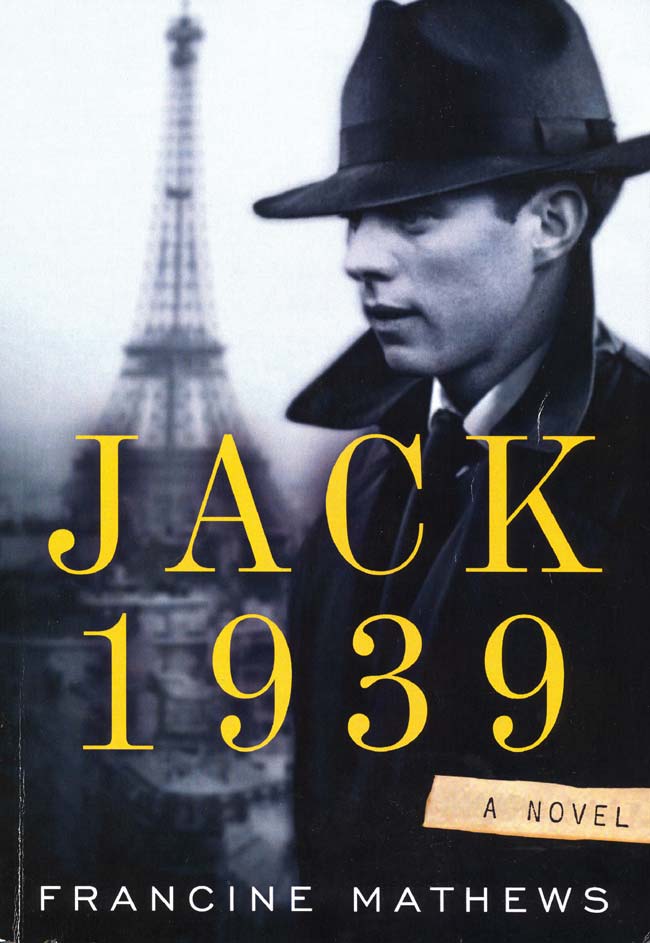
What if FDR sent a twenty-one year old JFK to Europe on the very eve of World War II itself in order to find out if and how Hitler was smuggling money into the US to influence the next election?
"I've been turning it over in my mind, Jack--this trip of yours," the President was saying. "To the Nazis, you're just the American ambassador's son. But to me, you're a perfect spy. My independent thinker. Arriving in London with a fresh outlook and an unclouded mind. As far as the Nazis are concerned, you're clean as the driven snow. They know your dad and I don't always agree. They'll never expect you to be my man in Europe."
Jack, who is as ill with some undiagnosable disease as he can be and not be dead, finds this proposal flattering and irresistible. If he's going to die at any moment any way, why not die being FDR's man in Europe?
So in Jack 1939 he boards the Queen Mary for England and nearly all the European capitals, closely pursued by the White Spider, a Nazi SS agent who is very quick with a very sharp knife, closely cultivated by German intelligence agent Willi Dobler, and intensely damned by every American ambassador in every European capital for the trouble he causes them, not excluding his own father. There is a beautiful older woman, Diana Playfair, another amateur spy with whom Jack has a passionate affair, whose ending will break your heart as painfully as it breaks Jack's.
One of the most enjoyable things in this book are all the walk-on parts by real people, beginning with Jack's family (Joes Sr. and Jr. don't come off all that well, and Rose, my god, Jack would have been better off with Dracula's bride as his mother) and including just about everyone else in the World War II Almanac.
Oh yes, J. Edgar Hoover is here, too, and up to his usual Machiavellian shennanigans. Fear not, FDR's got his number, and unbeknownst to Hoover, he's got Jack, too. A fun read.
# Permanent link to JFK, Spy
I tend to read in subjects, and lately it’s been Shakespeare, specifically A Year in the Life of William Shakespeare by James Shapiro, The Shakespeare Riots by Nigel Cliff and Shakespeare:The World as Stage by Bill Bryson.
Shapiro’s book takes 1599 as his text, the year William Shakespeare wrote Henry the Fifth, As You Like It, Julius Caesar, and the rough draft of Hamlet. It was the year, Shapiro says, that Shakespeare, at age thirty-five, “went from being an exceptionally talented writer to one of the greatest who ever lived.” This book is a word picture of Elizabethan London so vivid that you’ll smell the Thames at low tide as you read.
Three centuries later across the pond, New Yorkers rioted over the relative merits of Macbeth as played by a British actor and an American one. The National Guard was called out, people actually died, and the British actor had to be hustled out of the country for his own safety. America had embraced Shakespeare as one of their own, and he was read so extensively and so intensively that audiences from rural Kentucky to California gold mines could shout out the correct line when an actor in performance stumbled over it. Author Cliff concludes, “Once a voice carried a people across a continent and helped forge a brave new world. No other writer has been so powerful, and no one ever will be again.” This book includes a survey of 19th century American history, a history of Western theatre, is peopled with great characters and you-are-there settings, and has a quotable phrase on nearly every page.
# Permanent link to Shakespeare, explained. Again.
Bill Bryson brings his trademark witty style to his biography of the bard, but my absolute favorite chapter is the last one, wherein Bryson annihilates the notion that Shakespeare didn’t write Shakespeare. From eccentric Delia Bacon, a Francis Bacon adherent and wannabe relation, to the trio of alleged scholars rejoicing in the names of Looney, Silliman, and Battey arguing for the Earl of Oxford, to the theory that Christopher Marlowe was the real author of the plays (“He was the right age,” Bryson writes, “had the requisite talent, and would certainly have had ample leisure after 1593, assuming he wasn’t too dead to work.”), Bryson really enjoys himself, and, believe me, so will you.


Free land, my ass. According to this novel no one ever worked harder or suffered more disappointment than the original farmers who bought into the federal "giveaway" of Midwestern acreage provided by 1862's Homestead Act.
David and Mary Beaton nearly starve in their efforts to bust sod and plant wheat and make a living in Rose Wilder Lane's Free Land, in the teeth of rampant land speculators (that's who wound up with most of the Homestead Act land), winter-long blizzards, summer-long droughts, greedy store owners, outrageous freight costs, outlaws and not so hostile Indians. The story about the stolen papoose corpse is genius -- a better description of the clash of pioneer culture with Indian culture I never read. While the story is told from David's perspective, Wilder doesn't demonize anyone.
Another wonderful (and painful) scene is when they're harvesting fifteen acres of turnips and Mary's hands are bleeding and David wants her to stop and she won't because she hasn't been able to help him in any other way or earn any money the way she would have if they'd stayed in New York (butter, eggs). The sheer physical, mental, emotional and spiritual stress feels overwhelming to the reader, never mind the characters.
Rose Wilder Lane is of course the daughter of Laura Ingalls Wilder, and from what I can google this book is meant to be a fictionalization of Laura's parents' early years together, and fans of the series will recognize certain scenes. Free Land reads like non-fiction in its detail and its immediacy. There is a lot of romanticizing of this period of history elsewhere. By contrast, this book reads like the plain unvarnished truth. Well worth reading.
# Permanent link to Laura’s Daughter’s Take on Little House on the Prairie

They spoke of the days of plenty with a wistful exaggeration, as if it was an ancient time they knew only through stories generations old. My Jesus, the cod, the cod, the cod, that Crusade army of the North Atlantic, that irresistible undersea current of flesh, there was fish in galore one time. Boats run aground on a school swarming so thick beneath them a man could walk upon the very water but for fear of losing his shoes to the indiscriminate appetite of the fish.
# Permanent link to A Fishy Fairy Tale
On six occasions, his enemies had tried shooting him; twice, they'd attempted poison (once using a samosa laced with arsenic); and during the Case of the Pundit with Twelve Toes, a hired thug had tried to force Puri's car over the edge of a hairpin bend on the road to Gulmarg.
# Permanent link to “Saala, maaderchod!”*
The most ingenious attempt had been orchestrated by a cunning murderer (a naturalist by profession) working in Assam's Kaziranga Park, who had secretly sprayed Puri's clothes with a pheromone that attracted one-horned rhinos.
The closest anyone had come (not including the three rhinos, who could move surprisingly quickly) had been a criminal hijra who had pushed a pile of bricks off the top of a building into an alley in Varanasi where Puri had been walking.
Two men lay dead on a battlefield and one said “Hey!”
# Permanent link to War novel? Vampire novel? No, it’s just Peter Lovesey again.
You must understand, whoever you are, that in those days Rome, mistress of half the world, was a place as savage as a village of Nile pygmies.
Thus providing employment for our narrator, one Decius Caecilius Metellus, young commander of what passes for local law enforcement in his district of the city of the seven hills, circa 70BC. As John Maddox Roberts’ The King’s Gambit begins, someone is committing arson and garroting manumitted gladiators and rich freedman in Rome. In a plot that moves from simple murder to outright treason and threatens his own life, Decius’ investigation takes him into a Senator’s sister’s bed, to a brushing acquaintance with pirates (those same pirates who betrayed Spartacus, and here we find out why) all the way up to the Senate, including its two Consuls, Marcus Licinius Crassus and Gnaeus Pompeius Magnus.
Yes, that Crassus and that Pompey. One of the most enjoyable things about this series (which now numbers thirteen) is the cameo appearances by characters right out of the history books, like Gaius Julius Caesar (yes, that Caesar), as in
The new calendar was one of Caesar’s better ideas. (At least, he called it his calendar. It was Cleopatra’s court astronomer, Sosigenes, who actually created it, and in truth it was Caesar’s own neglect of his duties when he was Pontifex Maximus that got the old calendar into such dreadful shape in the first place. That’s something you won’t find in the histories written later by his lackeys.)
Ouch. But Decius gives the devil his due, too, as here
Hortalus gave very florid speeches, in what was known as the Asiatic style. He wrote the same way...Such writing reads very strangely now, since Caesar’s bald and unornamented yet elegant style revolutionized Latin prose. Between them, Caesar’s books and Cicero’s speeches utterly changed the language as it was taught in my youth.
The period detail is great, too, as when Decius goes to Ostia to interview a witness
From each shop front and storehouse came the fragrances of the whole Mediterranean world. Incense and spices were stored here, and rare, fragrant woods. The odors of fresh-sawn cedar from the Levant and pulverized pepper from even farther east mingled with those of frankincense from Egypt and oranges from Spain. It smelled like Empire.
Decius is an engaging character, not the ambitious social climber you’d expect from a young Roman on his way up, but a good man whose motivation to solve these crimes, as he confesses to his vestal virgin aunt, comes from not wanting to see innocent slaves crucified in lieu of the actual murderer.
Yet another true detail of soon to be imperial Rome that will make you glad you’re enjoying this story in a comfortable chair in your living room two thousand years later, and not living through it yourself.
# Permanent link to The Senate and People of Rome

[caption id="attachment_11324" align="aligncenter" width="422" caption="image from http://beatrice.com/wordpress/2009/07/21/rennie-airth-guest-author/"]
[/caption]
The setting is England. The first novel, River of Darkness, takes place soon after World War I, where a serial killer is charging into rural homes and slaughtering entire families. The second novel, The Blood-Dimmed Tide, takes place a decade later, in the depths of the Great Depression, and a homicidal maniac is targeting young girls for rape and murder. The third novel, The Dead of Winter (love that title), takes place in 1944, after D-Day but before the Battle of the Bulge, and an assassin for hire laying low in England during the war stumbles across a witness to one of his jobs who got away and leaves a trail of dead bodies behind him in a bloody search for the one person living who can testify against him.
The central figure of these novels is John Madden, first a detective inspector for Scotland Yard and then a farmer who in spite of himself is drawn back into the two subsequent cases. There are other great characters, too, Chief Inspector Angus Sinclair, John's boss, Billy Styles the boot constable, Helen Blackwell, the local doctor (love that name, too, Airth's done his homework) and many others, and part of the genius of these novels is that we get to see how things turn out for everyone because we are dropped into their lives at ten-year intervals.
Another reason I love these books is that Airth doesn't force us inside the minds of the killers (I am so sick of that). No, we learn about the villains one tiny piece of information at a time, just like the detectives do. These are police procedurals every bit as good as and maybe even better than Ed McBain's 87th Precinct series, and I never ever thought I'd say that about any novels.
Instead, Airth takes us into the lives of the victims, fully fleshed characters who are practically neighbors by the time he's done with them, and by then you're so worried about whether the good guys are going to get there in time that you're on the edge of your seat.
The setting is a you-are-there trip back to England in the 20's, 30's and 40's, and again, because we get to drop in once a decade we get to see how things turn out. The first novel is all about the cost of war, to John and to the nation. If you teach a natural born killer how to kill in war, what do you think he's going to get up to when you declare peace? The second novel is about what the powers that be will do to maintain that peace, and you will be every bit as disgusted as Angus is when you find out what they are willing to sacrifice in the name of national security. (Fuckers.) The third novel makes full use of world war as a plot device (there is a harrowing scene where the cops are about to make a raid and get blown up by a doodlebug instead), with fascinating detail of what it was like to live in London as well as the countryside during that time.
I just made a friend with a new iPad download River of Darkness, so they're available as e-books, too. Go get 'em.
You know why I picked up the first of these books? Because many years ago, I stumbled across a paperback copy of another book Rennie Airth wrote, called Snatch.
It's sort of a modern day Ransom of Red Chief, and it is hilarious. It isn't on Kindle yet and you can't have my copy, but there are a bunch of used copies on Bookfinder.com.
# Permanent link to The Return of Rennie Airth

This Friday the film based on Suzanne Collins' The Hunger Games opens, and we can only hope it is even half as good as the book. My review on Goodreads [SPOILER ALERT]:
This is a horrifyingly good book, so much so that I had to put it down twice and walk away before I could continue for fear of what would happen next. In a dystopian future US, there is no bread and only one circus, the Hunger Games, in which 24 "tributes" (forced volunteers) duel to the death on camera with the whole world watching whether they want to or not.
The narrator is a 16-year old girl, Katniss, the sole support of her mother and 10-year old sister back home. Her sister is chosen in the reaping and Katniss volunteers to take her place in the Games. The plot is like American Idol crossed with Survivor, only in this case children are killing children as a national spectator sport. By the last page you know what it was like at the Coliseum, from both the cheap seats and the floor of the arena. A riveting read.
And this is what I wrote about the third book in the trilogy, Mockingjay:
This is what Collins means these books to be about, right here
...Something is significantly wrong with a creature that sacrifices its children's lives to settle its differences...The truth is, it benefits no one to live in a world where these things happen.It sure doesn't. These three books work on several levels. First and foremost, they're a riveting read, an action/adventure tale that sweeps you along from first page to last. Katniss is a wonderful character, smart, strong, stubborn, taught by a hard life to have exactly the right skills she needs to survive the Games. Collins made an inspired choice to let Katniss tell her own story in first person present tense, which lends just that much more verisimilitude and immediacy to every event, without any assurance that anyone, Katniss included, is going to survive those events. You're on the edge of your seat for the whole narrative. Taken simply as pure, breathless entertainment, these books totally rock.
Second, not only does Katniss kick serious ass, she instinctively says and does the right thing when everything is on the line. She's a role model I'd be happy for any girl to aspire to. Or any woman, for that matter. I love Harry Potter, I do, but it's always bugged me, just a little, that the books weren't about Hermione. I know, I know, teachers and librarians say you can't get boys to read books about girls, but let me tell you, I've made grown men read these books and they can't put them down. So maybe the Hunger Games books are the beginning of a paradigm shift in reading habits. I so hope so.
Thirdly, Collins has a message. She puts these randomly selected kids into an arena to kill each other on a homicidal version of American Idol, all to serve as an annual object lesson that furthers the political stranglehold of the Capitol on the twelve Districts. By not flinching away from just how brutal those deaths are, she puts us personally on the battlefield. I can still see that spear going through Rue. Man, I can hear it.
How many Rues does the human race sacrifice before we figure out how to live with each other? I think Peeta was onto something, Katniss says, about us destroying one another and letting some decent species take over. Because really, I think Collins is saying, what is the alternative? Children dying.
The best science fiction is more than just a good story, and these books are an exemplar of the "if this goes on" trope. Collins is holding up a mirror and showing us exactly who we are.
I really like the ending, too, and not just because I was a Peeta girl from The Hunger Games on. Again, Katniss did the right thing like she always does and took down the right person. Her way back from everything that has happened to her is long and filled with pain and grief. This isn't a happily ever after, and it shouldn't be.
But, boy, it is a good read.
[youtube http://www.youtube.com/watch?v=kij2kzRC_YA&w=640&h=360]
# Permanent link to No Bread and One Circus

He had worn [his gun] on duty on only three occasions in his ten years in the Police Municipale. The first was when a rabid dog had been sighted in a neighboring commune...The second was when the president of France had driven through St. Denis on his way to see the celebrated cave pantings of Lascaux nearby...The third time was when a boxing kangaroo escaped from a local circus. On no occasion had Bruno’s gun ever been used on duty, a fact of which he was extremely but privately proud.
# Permanent link to Miss Marple meets A Year in Provence