Did you know the last shot fired in the Civil War was fired in the Aleutians? You would if you’d read Confederate Raider by Murray Morgan, a book about the Confederate raiding ship Shenandoah, built and commissioned to disrupt if not destroy the Union’s whaling industry in the North Pacific. Built in England, armed in the Madeira Islands, the Shenandoah travels around the Cape of Good Hope and starts sinking Yankee whaling ships from the south Atlantic on. But unbeknownst to them, the war ended in the middle of their search and destroy cruise. When they discover this they are afraid to surrender to a Union ship for fear they will be sunk out of hand, so successful has been their mission, so in an extraordinary feat of seamanship they sail south, dodging irritated Union vessels all the way, round Cape Horn and surrender to the British back in the UK, completing the journey without suffering a scratch. One of the great sea stories.
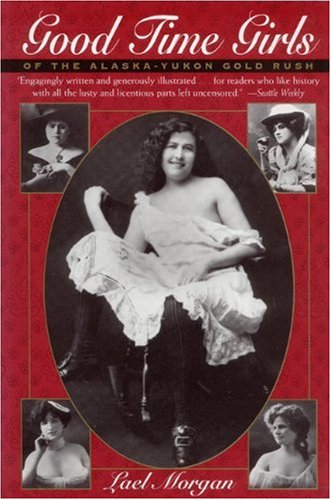
If you’re interested in the Gold Rush there is no better book on the topic than Pierre Berton's The Klondike Fever, but I also love Good-time Girls by Lael Morgan. This history of the women who came north with the stampeders to mine the minors in saloons, dancehalls and hookshops from Dawson to Nome to Cordova is filled with anecdotes of those days when an attractive woman was literally worth her weight in gold. French Marie, the Oregon Mare, Black Mary, Klondike Kate and more, Lael’s affection and respect for these women, whom she regards as pioneers, rises up from every page of this book. And wait till you find out who the Sterling Highway was named for. I think of him everytime I drive to Anchorage.
The Thousand-Mile War by Brian Garfield is a page-turner set in the Aleutians during World War II. Six months after Pearl Harbor the Japanese took the islands of Attu and Kiska, catching the United States by surprise for the second time in six months and putting Alaska and the west coast seriously at risk from invasion. (If you are geographically challenged and this makes no sense to you, see the Great Circle Route.) America scrambled to respond, and for fifteen months the two nations slugged it out in ice and snow and fog. In the end, the Aleutian Campaign tied up a sixth of the Imperial Japanese Air Force and 41,000 ground troops, forces which McArthur and Halsey did not have to fight further south. Complete with maps, illustrations and notes. Garfield was a crime fiction writer, which may account for the lively prose. This is not a tale that will put you to sleep.
Many Battles by Ernest Gruening is a personal narrative written by one of Alaska’s territorial governors and later a US Senator, one of two to vote against the Tonkin Gulf Resolution. A practicing politician, Gruening still grinds less of a personal ax than most, and he’s a good writer. His eyewitness account of Elizabeth Peratrovich’s speech before the territorial legislature in 1948 on the subject of Native suffrage will give you goose bumps. For that reason alone it stays on my bookshelf and I pull it down ever year or so to reread that scene. Sometimes we get things right.
Never mind the elections of 2000 and 2016, I’ve disliked the whole notion of the Electoral College since learning about it in civics class in high school. In his book, Let the People Pick the President, Jesse Wegman writes …the Electoral College…too violates the core democratic principles of political equality and majority rule. We may all…
Mark Kurlansky (author of among other books of Cod, Paper, and Salt) takes Martha and the Vandellas’ ‘Dancing in the Street’ as his guide to write an account of the transformative year of 1964. It was the year the Beatles formed the advance troops of the British Invasion. It was the year of Freedom Summer in Mississippi, when…
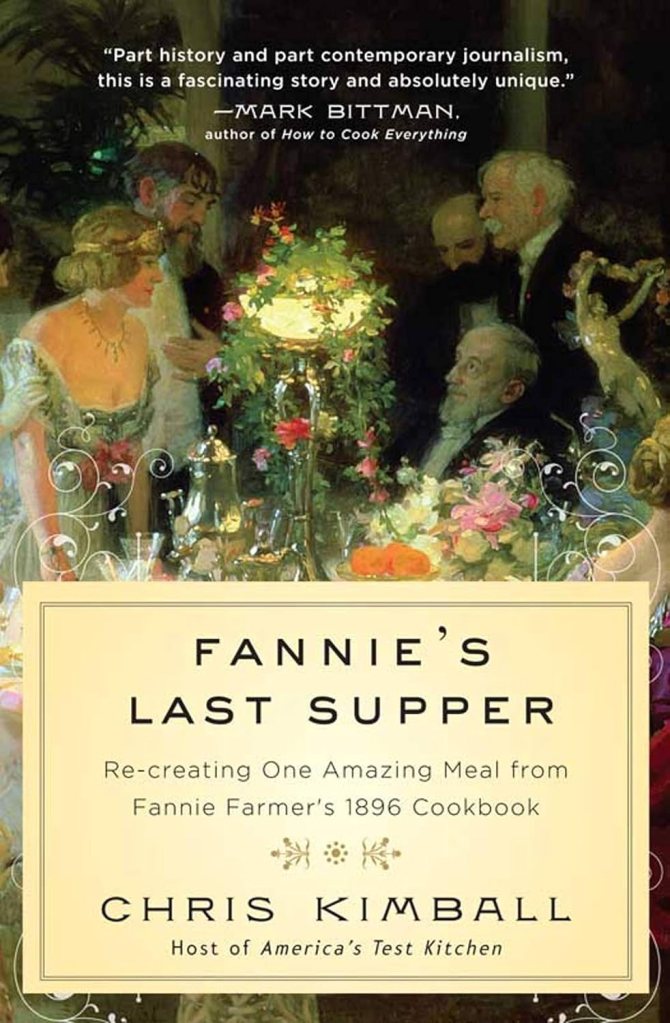
Christopher Kimball, whom I know well from my subscription to Cook's Illustrated, finds an old cookbook in an older house and spends two years translating and testing recipes to put on a Victorian spread for twelve (using a coal stove, no less, which I find by far and away the most horrific part of the process). Along the way, Fannie's Last Supper treats us to a history of Boston by way of fresh oysters and calf's foot jelly, in Fannie Farmer's kitchen.
I love The Fannie Farmer Cookbook, it is my go-to cookbook whenever I pull something unidentifiable out of the freezer and need a recipe to put it in. I am seldom skunked by any one of the recipes. So I was amazed to discover that Fannie was more of a marketer than a cook, but if she inspired my favorite cookbook, so what?
I would have preferred more about the preparation of the food and less of the history of Boston markets in this book, but there are wonderful observations and nuggets about Victorian dining habits that make the book well worthwhile:
"Victorians were also less apt to invite friends over for dinner. Dining in someone else's home was an intensely personal event, and an invitation was the "highest form of social compliment.""
and
"The essence of table etiquette in Victorian times derived from the disturbing relationship between eating and animal behavior. One manual said, "Eating is so entirely a sensual, animal gratification, that unless it is conducted with much delicacy, it becomes unpleasant to others." These dinner parties were, in effect, a test of one's control over bodily appetites."
I'll never make a Victorian, I like to eat too much, but reading the book I was immediately inspired to create an Alaskan-style Victorian menu. I'd make the punch directly from Kimball's recipe for Victoria Punch, it sounds fabulous, and he and his co-conspirators certainly made and sampled their share. I can get oysters right across the bay. If I could wrangle some moose bones from friends I could make a clear moose bone broth. The fish course could be either salmon or halibut, whatever is fresh out of the Kachemak at the time. Venison from Kodiak, I have a source. Poultry, hmmm, maybe duck? Or, hey, maybe ptarmigan, my dad used to serve a fabulous pan-fried, oven-finished, wine-soaked ptarmigan breasts dish.
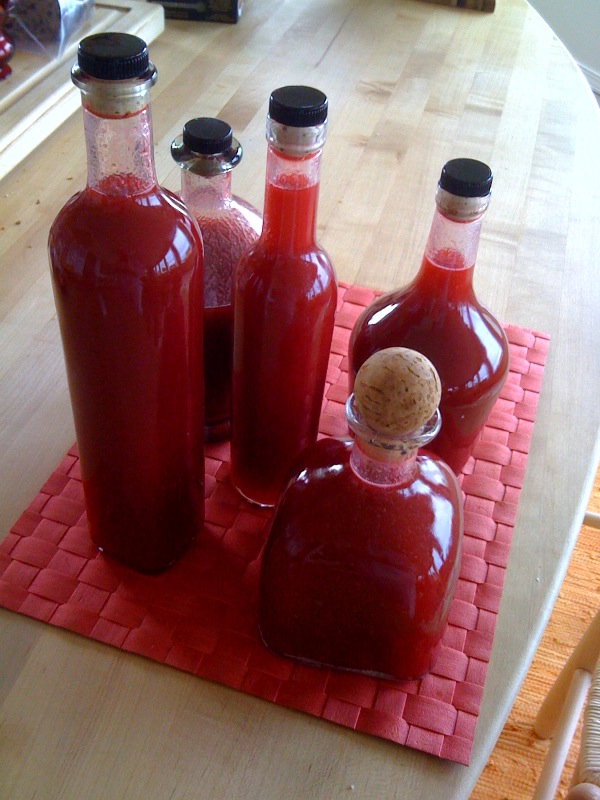
Vegetable, a potato gallette, from Yukon Golds grown in Alaska, but of course! Raspberry sorbet, from Alaskan raspberries. Burned butter frosting cake, not particularly Alaskan, but one of my favorites, and I know I can make it successfully. The cheeses will have to be from Costco. Only one liqueur, my grandmother's framboise.
Serving twelve? Maybe eight. In two hours? Even Kimball could only manage four and a half. Still sounds like a lot of work, but as Kimball rightly says, "...cooking, it seems to me, offers the most direct way back into the very heart of the good life. It is useful, it is necessary, it is social, and it offers immediate pleasure and satisfaction."
They did a PBS special on it, too, I can't wait for it to be on DVD. The one thing lacking in this book is photographs.
Lewis Lapham interviewed Richard Cohen on the publication of this book, and I read it mostly because of the whole 37 pages on women historians. It’s not Cohen’s fault. Apart from Sappho, we possess almost no female voice from the ancient world…Clever women were a threat to men, thus the myriad stories of women’s vanity,…
An invaluable oral history. Be warned, though–some of these stories are painful to read. These women were so young and inexperienced and ripe for exploitation, professionally and personally. It amazes me all over again the quality and quantity of art they produced. Yes, I will love you tomorrow and for all the rest of my…
Mammoths walk the earth again, thanks to a billionaire’s de-extinction project. He sequesters these prehistoric zombies in a remote valley in Colorado and charges other billionaires $10M a pop or so to come gawk at them. All well, then, nothing to see here, move it along, and you and I couldn’t afford it anyway. But.…
I bought this book at the visitor center at the Little Bighorn Battlefield National Monument in May and started reading it immediately, having been so powerfully affected by the ranger talk and the driving tour of the battlefield. The good news is that it is very well written. The bad news is that this is…
Killers are posting video of murders online. The killers are so good at concealing their online IDs that the FBI convenes a group of the worst known hackers to ask for their help. Monkeewrench, aka Grace MacBride, Annie Belinsky, Harley Davidson and Roadrunner, computer nerds extraordinaire, steps up to help Minneapolis police detectives Leo Magozzi…
VCI head Eddie Mahler starts his day with possibly the worst online date ever and returns to the office to find the officer he lent out to Narcotics has been stabbed with a rapier. And the FBI is blackmailing another of his officers to rework a case she left behind when she quit them and…