Robert Broke moves to Florence after the tragic death of his wife and unborn child, and stumbles into a conspiracy to fake and sell Etruscan artifacts about which he knows far too much for the comfort of the crooks. His friends rally round to find out the truth.
There's your generic capsule summary of the plot, and it's a good one, but oh, the characters are lovely, especially the expatriate English, as for example
Miss Plant was, in every sense of the word, the leading lady of the English colony in Florence. She had been there since around the beginning of the century. The accident that Italy had happened to be on the wrong side in the Second World War had not incommoded her at all. It had, in truth, served to emphasize her standing and increase her prestige. It was true that the Italian authorities, badgered beyond endurance by the Germans, and after exhausting every excuse for delay, had eventually agreed to take Miss Plant into custody as an enemy alien. The experiment had not been a success.
to the extreme discomfort and eventual post-war social ostracism of the Questore, the Italian official who had so briefly taken her into custody. Then there is the English counsel, Sir Gerald Weighhill, pronounced "Whale"in case there is any doubt after the following passage:
Sir Gerald was the finest specimen of all Weighhills to date. He turned the scale, in his underpants, at two hundred fifty pounds, moved with the majesty of an aircraft carrier, and needed, unkind persons asserted, almost as much seaway to turn in. While he was still at an early age it had become clear that such talents must lead him into the Foreign Service.
And so it does. There are some marvelous Italian characters, like Tina and her mother Annunziata, Marco the Sindaco and Riccasole the attorney, and the bad guys are conscienceless enough to send a chill down the spine, and the setting is wish-you-were-there Tuscany. A fun read all around.
A wide-ranging selection of viewpoints by writers to Morocco, from the romantic
The every-changing scene is a kaleidoscope of Eastern fancy: Ali Baba and the forty thieves, Blue-beard, Aladdin and the Grand Vizier -- all in succession pass before us.--Budgett Meakin
to the brutally real
As the corpse went past the flies left the rstaurant table in a cloud and rushed after it, but they came back a few minutes later.--George Orwell
There is a mesmerizing as-told-to author Gavin Maxwell (Ring of Bright Water) eyewitness account of the brutal end of one regime
I was only a child when these things happened, but I remember them well, though I don't like to remember them or to think that I laughed to see a man burnt alive.
And you won't enjoy reading it, either, but you won't be able to stop yourself. There are marvelous word pictures
On the fringes of the square, letter-writers and fortune-tellers sit cross-legged with their clients; a solitary greybeard listens intently to his supplicant before handing him a minute philtre and a folded charm.'A Taleb -- student of the magic arts,' Quentin explains. 'The most experienced have the power to resolve unrequited passion by summon the object of your dreams, or to reunite you with a lost love.'
Moroccans seem very suggestible to occult practices, genies and the like.'
"The plural's "jinn."'--Anthony Gladstone-Thompson
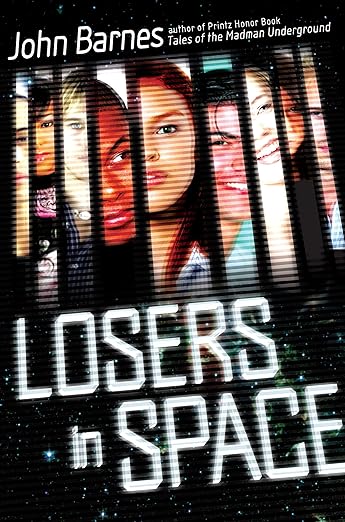
It's a couple of hundred years in the future and mankind has created a society free from want. Everyone is rich, no one is hungry or without shelter. What's the catch?
There's nothing to do. Except sit around and watch the meeds, which most do.
So Susan Teraville (aka Crazy Science Girl) and her other loser friends decide to stow away on the milk run of the Virgo, a cargo ship in orbit between Earth and Mars, and make themselves famous enough to become official celebrities, with their own meeds, for which they will get paid more than for sitting around doing nothing. (Some people are just never satisfied.)
As you might expect from a novel by John Barnes, all does not go according to plan, beginning with an accident (or was it?) that kills most of Virgo's crew and knocks her way off course, followed by a subsequent series of mysterious accidents (or are they?) that whittle down the losers down one at a time. Coping with disaster teaches Susan and her crew that maybe they aren't the losers they or their society thought they were, and the last chapter is is maybe the most satisfying revenge fantasy I've ever read.
A lot going on here, including interpolatory chapters called "Notes for the Interested." Barnes writes
In the main text, I'll explain only as muc as a reader needs to follow the story; if it's just more cool science upon which you may wish to geek, I'll package it in a Note for the Interested. You ca read the whole book and follow the story without reading a single Note for the Interested (if you're not interested). On the other hand, if you are interested, they're easy to find.
To paraphrase John Le Carre, this novel wears many hats upon its head. First off, it is a slam-bang action adventure story, a Tom Swift novel without the adverbs and with the tech based in reality. It's an exemplar of the sf "if this goes on" novel--the court case upon which the survival of the Virgo hangs is uncomfortably possible, or it is at least from a conservative perspective. It's a character study, in that it looks at what happens to five distinct character types locked up on a tin can in the middle of a vast expanse of nothing for almost two years, and since the narrative is in Susan's voice it is also an examination of the art and results of command.
Losers in Space would be a terrific novel to teach in high school. Teenagers will really relate to the characters, it's an interesting literary choice, and the Notes are a great first step into can-do science. A fun, fascinating and terrifying read.
A ripsnorter of an action adventure near future tale. Mankind has moved on to the asteroid belt and the gas planet moons but he hasn't entirely outgrown Tsiolkovsky's cradle. Earth is feuding with Mars, Mars is feuding with Earth, the Outer Planets Alliance is feuding with everyone, and the introduction of an alien bioweapon into this volatile mix brings them all to the brink of a war that will put a final period to human existence.
Except, and you knew there was going to be an except, for the efforts of salvage ship XO Jim Holden and Ceres beat cop Miller, one a straight-up guy who keeps getting runabouts/ships/habitats shot out from under him, the other an increasingly and disturbingly active member of the "justice delayed is justice denied" mindset. Together, can they save the Solar System? Maybe, if they destroy the Mormons' megaship first.
Oh yeah, if you like nuts and bolts sf and lots of space battles, this book is for you. Corey has a real gift for imagining what life will be like on the other side of the gravity well and, better, dumping us right in the middle of it. I'm into the second in the series already.
This novel is first and foremost a portrait of Shanghai in the early 90s, as China is substituting capitalism for Mao's Cultural Revolution with breakneck enthusiasm. Chief Inspector Chen Cao is called away from the dinner celebrating his new apartment by the discovery of the body of a young woman, tied up in a garbage sack and dumped in a rural canal. She has no clothes and no identification and it's a long slog before Chen finds out who she is. Finding her killer is hampered by Communist Party hacks who fear whodunnit may be someone the Party can't afford to convict, lest it reflect badly on the Party's spotless reputation, not to mention the Party's strong arm, Internal Security. Everything about the case is political, of course, but then so is everything else in Chen's world so what's new.
But what is most delightful here are the word pictures of every aspect of life in Shanghai lived at Chen's level. Want to make a call?
There were four phones on a wooden shelf behind the small windows. One phone was labeled "For Incoming Calls Only." According to Uncle Bao, the public phone service had been originally put in for the convenience of the dorm residents only, but now people in the lane could also use the phones for just ten cents.
"When a call comes in, I write down the name and call-back number on a pad, tear off that page, and give the message to the intended recipient. If it happens to be a dorm resident, I just need to shout the name at the foot of the stairs with a loudspeaker."
"What about the people who don't live in the building?"
"I've got an assistant. She goes out to inform them, shouting with her loudspeaker under their windows."
Need some groceries?
A long line stretched back from a fish stall. Aside from the people standing there, there was also a collection of baskets, broken cardboard boxes, stools, and even bricks--all of them placed before or after the people in line. At every slow forward step, the people would move these objects a step farther. Placing an object in line was symbolic, he realized, of the owner's presence. When a basket drew near to the stall, the owner would assume his or her position. Consequently, a line of fifteen people might really mean fifty people were ahead of him. At the speed the line was moving, he judged, it would probably take him more than an hour to be waited on.
How much would you pay once you got to the head of the line?
"It's all to Peiquin's credit," Yu said. "She managed to get all the crabs at the state price."
It was a well-acknowledged fact that no one could be so lucky as to buy live crabs at a state-run market. Or at the official price. The so-called state price still existed, but merely in newspapers or government statistics. People paid seven or eight times more in the free markets. However, a state-run restaurant could still obtain one or two baskets of crabs at the state price during the season. Only the crabs never appeared on the restaurant's tables. The moment they were shipped in, they were divided and taken home by the restaurant staff.
And quite right, too. Oh, you don't want to cook for yourself?
"Steamed ribs with bean sauce, chicken with sticky rice, steamed beef tripe, mini-bun of pork, and a pot of chrysanthemum tea with sugar," Ouyang said, turning to Chen with a smile. "These are my favorites here, but choose for yourself."
Followed by a small segue into the origins of dim sum. Chen eats a lot of terrific meals in this novel. I recommend reading it with a napkin in hand to mop up the drool.
Wondering about medical care in China in Chen's time?
"Dad, I'm calling from the local county hospital. Kangkang, our second son, is sick, his temperature is 104. The doctor says that it is pneumonia. Guolian has been laid off. We've got no money left."
"How much?"
"We need a thousand Yuan as a deposit or they won't treat him."
How about a cup of tea to settle the digestion after a lunch of rubbery chicken and noodles?
There was a whisper of southern bamboo music in the teahouse, perhaps from a tape player somewhere. A silver-haired waiter carrying a heavy shining brass kettle poured the water in a graceful arc into the tiny cup before Chen. There was lore to this. In ancient China, teahouse waiters had been called Doctors of Tea, and the teahouse was a place of spiritual cultivation, as well as where people exchanged daily information.
Okay, yes, some of the exposition does get a little lumpish on occasion, and the plot does take forever to unfold -- it's 137 pages before we even get a suspect -- and the resolution turns on the dea ex machina appearance of Chen's old HCC girlfriend (you'll know what HCC means by the end of the book, believe me). Inspector Chen, an aspiring Adam Dalgleish, quotes poetry ad infinitum and even has some published, Detective Yu is constitutionally pissed off except when he's at home being in love with his wife, Commissar Zhang is always Party hack first and cop second, and Detective Old Hunter Yu and Overseas Chinese Lu brighten up every scene they're in.
But the setting, oh, the setting. You will be transported across the Pacific and back twenty years, and you won't be sorry. And you'll want to go to Shanghai and Guangzhou just to eat.
On November 14, 1889, muckraking reporter Nellie Bly left New York City on the first leg of a round-the-world race to beat Phileas Fogg's time of eighty days. Fogg, you will remember, was a fictional character created by French author Jules Verne. Bly would not know until she reached Hong Kong that she was also in a race with a real person, another American writer named Elizabeth Bisland. Bly had three days to get ready, Elizabeth about twelve hours, Bly was traveling east, Bisland west. Bly's trip was funded by her employer, Joseph Pulitzer's The World newspaper, Bisland's by The Cosmopolitan magazine, for whom she freelanced. The two women could not have been more unlike, as the trip was all eager Bly's idea and reluctant Bisland was fairly dropped in it by her editor. Both publications were in it to raise circulation.
This was a time when women were, quote, cherished, end quote out of anything that had anything to do with anything other than marriage and children. Just being reporters put Bly and Bisland beyond the pale
”I have never yet seen a girl enter the newspaper field but that I have noticed a steady decline in that innate sense of refinement, gentleness and womanliness with which she entered it,” observed one male newspaper editor. “Young womanhood,” rhapsodized another, “is too sweet and sacred a thing to couple with the life of careless manner, hasty talk, and unconventional action that seems inevitable in a newspaper office.”
Sweet and sacred Bly, twenty-five, and Bisland, twenty-seven, wrote for a living. Bly was the sole support of her mother and later her sister-in-law and her children. Bisland supported herself and her sister. Bly was an investigative journalist before the job title existed who contrived to report from inside an insane asylum for women, while Bisland wrote book reviews and hosted literary salons in her New York City apartment. Both were feminists and activists, although neither would have described themselves as such, and both went around the world alone, although neither woman experienced any real hardship as each was sent first class at their publisher’s expense.
One of the fascinations of this book is the detail over what each woman packed. Bly carried one small bag
a sturdy leather gripsack measuring at its bottom sixteen by seven inches. In that small space she managed to pack a lightweight silk bodice, three veils, a pair of slippers, a set of toiletries, an inkstand, pens, pencils, paper, pins, needles and thread, a dressing gown, a tennis blazer, a flask and drinking cup, several changes of underwear (flannel for cold weather, silk for hot), handkerchiefs, and a jar of cold cream to prevent her skin from chapping in the various climates she would encounter.
Measure that out on your desk. Rick Steves could take lessons. This was deliberate, as Bly
wanted to give the lie to the timeworn notion that a woman could not travel without taking along several pieces of luggage.
and a leading travel writer of the day recommended the female traveler, in addition to a small steamer trunk and a satchel, take another trunk fourteen feet square at its bottom. Bisland in a much shorter time packed a lot more than Bly, and she must have regretted it when the French customs inspector had her clothes strewn all over the deck.
In the end, Bly beat Bisland by more than four days, and returned home to a hero’s welcome. People named daughters, race horses, spaniels and Buff Leghorn chickens after her, musicians wrote songs about her, and manufacturers used her name to sell everything from clothing to school supplies to chocolates. Alas, it didn’t last.
In London, The World’s Tracey Greaves paid a visit to the president of the Royal Geographical Society. “While I can’t see that her trip will benefit the cause of science,” observed the Right Honorable Sir Mountstuart Grant Duff [Really, he could have been named for the purpose.], “...Miss Bly has proved herself a remarkable young woman, and I hope she will get a good husband.”
That’s right, little girl, you did your stunt, now go home and be quiet.
The World published her photograph and everyone knew what she looked like, so there was no going back to her job as an undercover muckraker, and she had no talent at fiction, the only writing job she could get. The revisionist history started in almost immediately, as Americans then as now can’t wait to tear down the legend they have only just built up, and Bly didn’t help things by embellishing the legend herself.
Still, I wonder, would as many women have undertaken to climb the Chilkoot Trail had it not been for Nellie Bly’s showing the way a decade earlier? How much effect did Bly’s circumnavigation of the globe have on the passing of the nineteenth amendment thirty years later? How many "sweet and sacred" little girls played the Nellie Bly Around the World board game and were encouraged to believe they, too, could go round the world? be a doctor? lawyer? Indian chief?
I do have some problems with this book, in particular Goodman's differing attitudes toward Bly and Bisland (He is in love with Bisland and loses no chance to denigrate Bly whenever he can) but highly recommended anyway, not only as a good story but as a you-are-there portrait of the time in which Bly and Bisland lived. How soon we forget how far we have come.
Brilliant genetic scientist Dr. Alexander Wolfe drives his car over a cliff one evening in southeastern England, and insurance adjuster Peter Manciple comes along behind to make sure that there is no reason that his firm shouldn't pay out on Dr. Wolfe's very large and oddly written insurance policy. All, as you surely knew, is not as it seems, and mayhem and bloody murder ensue.
Can I get away with using "quiet" to modify the noun "thriller?" Because that's what many of Michael Gilbert's books are, quiet thrillers. He has the endearing habit of elevating ordinary people by way of extraordinary circumstances to heretofore unthought of actions, and after the authorities come gallumphing in to investigate and inquire and pry and explain and justify, our not quite Ordinary Bloke carries on with his life. And then there are the always perceptive comments on Life, the Universe and Everything, and the sly asides that yank you up with a jerk and make you read them twice to make sure he really said that.
Another thing I like about Gilbert is that he doesn't always tie things up neatly at the end. The Empty House's conclusion is more neat than most, but you certainly understand Peter's ultimate decision.
***SPOILER***
Also, I'm not all that certain that Dr. Wolfe is really dead. He's been dead before.
Here, in the sixth and final installment of the Charlie Hood series, Charlie literally wrestles with the devil himself, over the narcotraffickers on the USA-Mexican border, for the lives of his friends, and maybe even for his own soul as well. A very satisfying conclusion, although I'm actually a little spooked at the way he left it.***[spoiler below]
These books are desert noir, a lone hero walking the harsh sands beneath a merciless sun, Sam Spade among the cholla, and always with the hero's past somewhere rearing its malevolent head. Here it shows up up front, on page 36:
The past again, he thought. Barreling right in like it's welcome.
Raymond Chandler Himself would expire from sheer envy.
There is as always great craft, both undercover agent and writer's:
Hood ignored him. Let them come to you, he thought. This was a favorite rule of his old Blowdown boss, Sean Ozburn, a crack undercover agent, always cool and never made: Don't be eager. Ozburn had been the best of them unti mike Finnegan tore him to shreds--mentally, spiritually, and finally physically. Oz's lovely wife, too. All of that, without touching them.
There is so much going on in that paragraph I hardly know where to begin. It illustrates Hood's experience as an ATF agent. It lets you in on a little secret about working undercover. It sets up the villain, and it invokes the reader's sympathy for past (and passed) friends. That, folks, is not an expository lump. Later on:
To Hood, Dale Yorth was the combination of boyish adventurism and deadly adult mission that constituted law enforcement at most levels.
Ever see what cops call a trophy shot, with all the arresting officers grouped around big piles of marijuana bales or bags of cocaine? Reminds me of Holmes -- "Quick, Watson! The game's afoot!" If they didn't enjoy the chase, they wouldn't be in the game, and Jeff captures that here in one sentence.
There is, as always, some great social commentary:
Hood had always thought that, just for starters, ATF had it rough because most Americans liked alcohol, tobacco and firearms, and disliked regulation.
And then we come to Mike Finnegan, the Big Bad. He explains himself to Bradley, the struggle for whose soul has occupied much of the Charlie Hood series:
My partners have all been very, very successful. I try my best to get to them by age eleven, and I have rigorous standards. The single best prognosticator for success as a partnered human being is ambition. This is where everything begins. Second greatest? Appetites--indulged appetites. Third? Perfectionism. I look for monstrous, gigantic egos linked closely to a sense of entitlement and possessing a simple can-do attitude.
[Shudder.] Practical, isn't he? And prescient. And persuasive. And...political, if you want to look at it that way and I don't see how you can avoid it. Jeff has made me believe in the devil in the way no church has ever been able to.
One day, these novels will be read in history classes, in poly sci classes, and maybe in theological classes as well. Highly recommended.
Here comes the SPOILER:
***Although I guess one should never be entirely certain that the lock on the devil's door is unpickable. Myself, I think Bradley's right, he and Reyes and Charlie should dump Mike down Beatrice's mine shaft. Better yet, just back up a cement truck and unload it into the basement.
Not to be confused with Samuel Johnson, who wrote the dictionary, which I always do. No, this book is a biography of Samuel Pepys, who wrote the Diary. An up-from-nothing country boy, Pepys' abilities and high-placed relatives put him at the center of English history for the last half of of the 1600's. He witnessed the execution of Charles I, rose high in Cromwell's administration, turned his coat when Charles II was restored to the throne and rose even higher, and then backed the wrong horse when Charles II died and James II took only four years to whistle his throne down a religious wind of his own making. Pepys, the last man in the world to end his life as a Jacobite, does, out of loyalty and a stubborn determination to turn his coat no more.
This is the best kind of biography, not only the life of the man himself but of the time and place as well. Tomalin wisely relegates the Diary to it's own section, the years 1660-1669. In the prologue, she writes
The shamelessness of his self-observation deserves to be called scientific.
and then places his words alongside the narrative of those years.
The Diary, with its tumbling stream of information, is a reminder that the moods and demands of daily life easily blot out politics. Lack of cash was a more pressing problem for Pepys than any possible change of regime...
Tomalin isn't above inserting the occasionally acid and always enjoyable editorial comment, either.
Almost the first advice Pepys got when his promotion was known was from a sea captain telling him how to fiddle his expenses by listing five or six non-existent servants when he went on board and claiming pay for them all. It made an interesting introduction to the workings of the navy.
Tomalin shows a masterly hand at drawing comparisons between that time and this, as well. On Major Harrison being hanged, drawn and quartered for treason:
Pepys, in one of his most famous formulations, wrote that Major-General Harrison looked "as cheerfully as any man could do in that condition."...Pepys did not devote the rest of his day to higher thoughts any more than one of us, turning from famine or child murder on television, remains sombre an hour later.
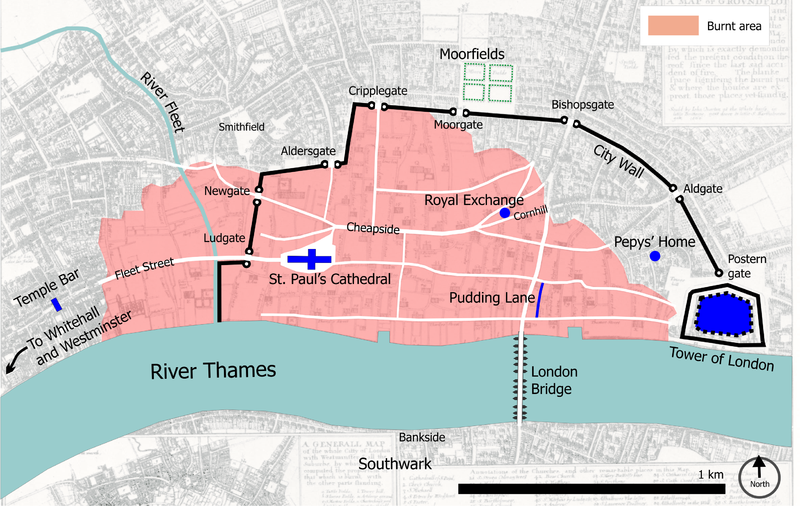
Due to his high office and connections at court Pepys' had a front row seat to all the goings-on, and as secretary to the British Navy a not inconsiderable hand in affairs himself. On every page you aren't bumping into royalty, you stub your toe on someone out of the Who's Who of British science and literature, John Milton, John Dryden, Andrew Marvell, Christopher Wren, Isaac Newton, Robert Hooke, and many more. In the meantime, through Pepys' eyes we singe our eyebrows on the Great Fire of London, and fear for our lives from the plague. It's a marvelous you-are-there.
I was raised on a 75-foot fish tender in the Gulf of Alaska. In port, at low tide, it was a forty-two foot climb up an often ice-encrusted ladder to get to the library, but if you’re a born reader and an icy climb is the only way you can get to the library, you climb.
The Seldovia Public Library was one room in the basement of city hall. It was open once a week, on Monday nights, for three hours, seven to ten. Because there were so few books, each patron could check out only four at a time. Susan the librarian started me on Nancy Drew.
I read all the Nancy Drew Susan had in short order, and then I read everything else on her shelves. Because I was a kid on a boat, I was always looking for stories about other kids on boats. Eventually, Susan found me a copy of The Lion’s Paw by Robb White.
It’s World War II. Fifteen-year old Ben’s father is lost at sea in the Pacific. Penny and Nick are siblings on the lam from the orphanage that would split them up. They stow away in Ben’s sailboat, the Hard A Lee. Ben’s uncle is going to sell it, so Ben, Penny and Nick decide to run away on the Hard A Lee together.
My favorite kind of book is a how-to book. You can’t put enough detail into a book about how someone lives their life or does their job or falls in love or commits a crime to suit me. The Lion’s Paw is a how-to book. How to run away. How to sail a boat. How to be a captain. How to be crew. How to hide a sailboat in plain sight. How not to wrestle an alligator.
How to go on a quest.
There is that one book every writer can point to as the story that inspired them to tell their own. The Lion’s Paw may be the first book I ever read where I looked at the author’s name on the cover and wondered, “Who is this guy? How does he know all this stuff?” and more importantly “Did he write anything else?”
He did, and I read it all. And then I started writing my own.
And it is finally again in print. Buy it here. I promise you won't be sorry.
The Family Tomb by Michael Gilbert
Marrakesh: Through Writers' Eyes by Barnaby Rogerson
Leviathan Wakes by James S.A. Corey
Death of a Red Heroine by Qiu Xiaolong
Eighty Days: Nellie Bly and Elizabeth Bisland's History-Making Race Around the World by Matthew Goodman
The Empty House by Michael Gilbert
The Famous and the Dead by T. Jefferson Parker
Samuel Pepys: The Unequalled Self by Claire Tomalin