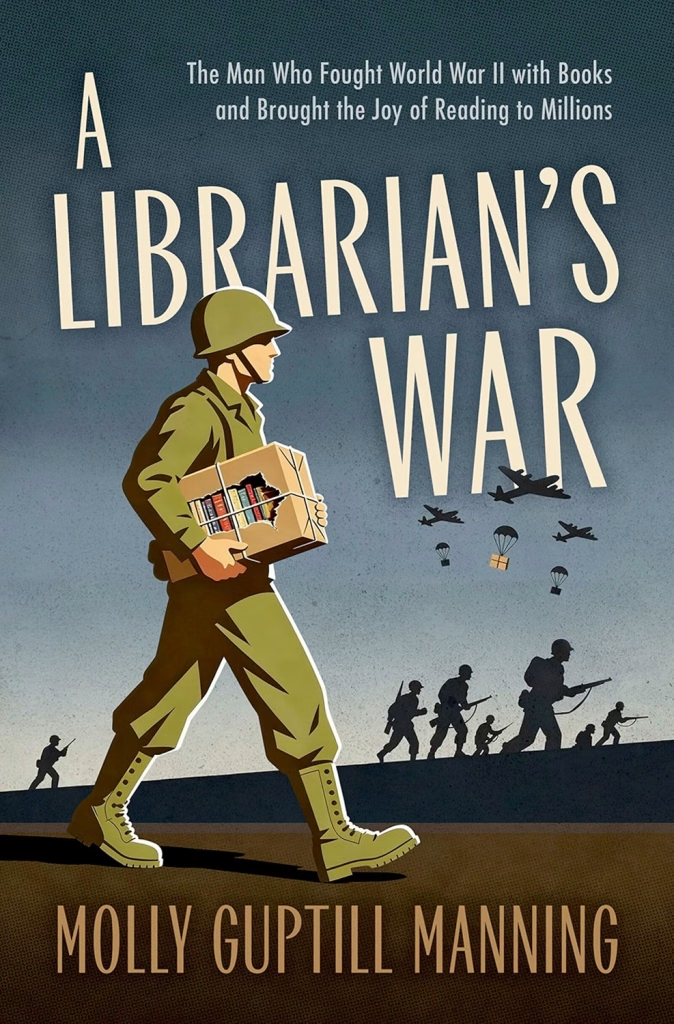
Born a Kentucky farm boy, Ray Trautman joins the US Army because he wanted to be a pilot. He washes out because of bad eyesight, and reverts to his first love, reading, and graduates from Columbia with a degree in library science. After working in public libraries, managing independent bookstores, building libraries for the Civilian Conservation Corps, and mining for gold in British Columbia (because why not), in 1940 he was hired as the first Chief Librarian of the U.S. Army.
Trautman wasn’t sure at first whether he had been given the chance of a lifetime or a fool’s errand. He was tasked with building a comprehensive library system for the entire US Army, but because the ALA had fund-raised and purchased books for the Army’s libraries in Word War I, there was no precedent for how an officer would obtain congressional funding to do this work. At the age of thirty-three, he was now in nominal charge of a patchwork of outdated libraries spanning the United States. While the Army was on pace to swell to 1.5 million draftees in 1941, Trautman had 500,000 books and a staff of two civilian clerks.
Trautman, like every good librarian, decides to get to know the men who would be his patrons, and sets out on a tour of the Army’s bases, where he finds all the Army’s libraries understocked, and underfunded, not to mention under-appreciated by officers up to and including Douglas MacArthur, who sounds as big a twat as ever wore stars.
Trautman thought it strange that the Army seemed indifferent to the important role of books in this war. The freedom of information was one of the foremost principles at stake. Beginning in the fall of 1933, Nazi Germany began to impose restrictions on books, producing lists of authors, subject matters, and titles that were consider so danger that they were banned and burned…What started as a ban on a few hundred titles in 1933 grew to restrictions on thousands of titles and author b y 1938…By 1945, it is estimated that over 100 million books were destroyed across Europe by the Nazis…The best way to fight this censorship spreading across Europe was to fill library shelves with diverse ideas, enabling Americans to exercise their democratic “freedom of access to the printed word.”
He perseveres, and after Pearl Harbor when the war begins in earnest the men in combat on every front clamor for books to read as an escape from the terrors of combat and the boredom of waiting to be in combat. The best photo included in this book is the one of the soldier laying on an Army cot whose surface is barely above the level of the water of the swamp in which his unit is located, reading an Armed Services Edition. That, right there, was who Trautman was fighting for. It is the featured photo for this post.
Ah yes, the ASEs. It wasn’t only the Army brass Trautman had to fight, it was publishers, too, who were terrified that paperback books would cut into the market for their hardcovers and at first refused outright to print any whether they were for soldiers or not. The problem was hardcover books weighed two pounds each and no soldier was going to add that to the already forty or fifty pounds of gun, ammo, and gear he was humping into the front lines.
Trautman, as was his invariable habit, invented a work around. What if the Army came up with a design for a paperback edition of popular books to be distributed only by the Army only to American soldiers at the fronts, a cheap edition the exact size and shape to fit in the breast pocket of their uniform? It isn’t easy but eventually he pulls brass and publishers into common cause.
By July 1943, thirty titles were selected by council members and military library staff to compose the first month’s batch of books…They typically aimed to include titles scattered across twelve main subject areas: contemporary fiction, historical fiction, autobiographies and biographies, westerns, adventure novels, mysteries, classics, short story collections, travel, history, science, and poetry.
A favorite was Betty Smith’s A Tree Grows in Brooklyn.
When it came to requests for specific titles, soldiers seemed to overwhelmingly seek books that reminded them of home and family…one hospitalized Marines said that two years of combat had numbed him; he carried a “dead heart” and “dulled mind” and had no hope for the future. To pass the time, a nurse happened to give him the ASE of A Tree Grows in Brooklyn. “I can’t explain the emotional reaction that took place,” the Marine said, but “this heart of mine turned over and became alive again.” and he dared to believe that “maybe a fellow has a fighting chance in this world after all.” There was no medicine that could bring such a result. But a book could.
Trautman’s efforts bring him to the attention of General Eisenhower, a reader of ASEs himself, who calls him to Paris and then sends him—admittedly unbeknownst to Eisenhower or anyone else in the Allied command—right into the beginning of the Battle of the Bulge. On a fact-finding tour of forward bases, wondering why all the road signs had been removed and all the telephone lines cut, Trautman and his driver stop to look at a map and are surrounded by a random group of American soldiers on the run from the attacking Germans who are as lost as they are. Trautman, the only officer, takes charge, tends to the wounded, drives everyone to the nearest village, finds shelter in a deserted building, and everyone wakes up to discover that they’ve been surrounded by German tanks.
His car, which remained hidden, had gasoline in the tank. In the middle of the night, Trautman ordered his men to silently father the empty bottles and siphon gasoline into them. Plugging each bottle with a wad of fabric, they made as many Molotov cocktails as they could. They might not have guns, but they wouldn’t be empty-handed.
When Allied bombs take out the first and last in the line of German Panthers and Tigers
Trautman ordered his men to grab their homemade incendiaries and take the rest out. Lighting their Molotov cocktails, the Americans dropped them into tank turrets and threw them against the tanks’ lightly armored rears to knock out engines and set them aflame; if their crews were inside and tried to bail out, Trautman’s men would have to fight as best they could.
After it was over, Trautman spent the next two days evacuating his men, helping them reconnect with their units, and tending to those who were wounded. He spent Christmas Day in a hospital in Belgium with his injured men. He distributed some of the ASEs he had packed in his car.
Because of course he did.
After the war Trautman teaches library science at Columbia, constantly updating the curriculum with new programs he pioneers to provide libraries to mental institutions and the blind and the far reaches of the territory of Alaska, so I’m a beneficiary, too. So are we all.
While [Trautman’s] influence was palpable in predictable ways—the exponential growth of the postwar paperback industry, for example—it also took surprising forms, such as making an impression on American home design…As housing development mushroomed across the United States, middle-class living rooms included a ubiquitous new feature: built-in bookshelves. Veterans, used to carrying ASEs in their pockets, could not imagine their civilian lives without books within arms’ reach.
Book Review Monday Chatter A Librarian's War Molly Guptill Manning

1 Comment Leave a comment ›
What a story! What a genius!