

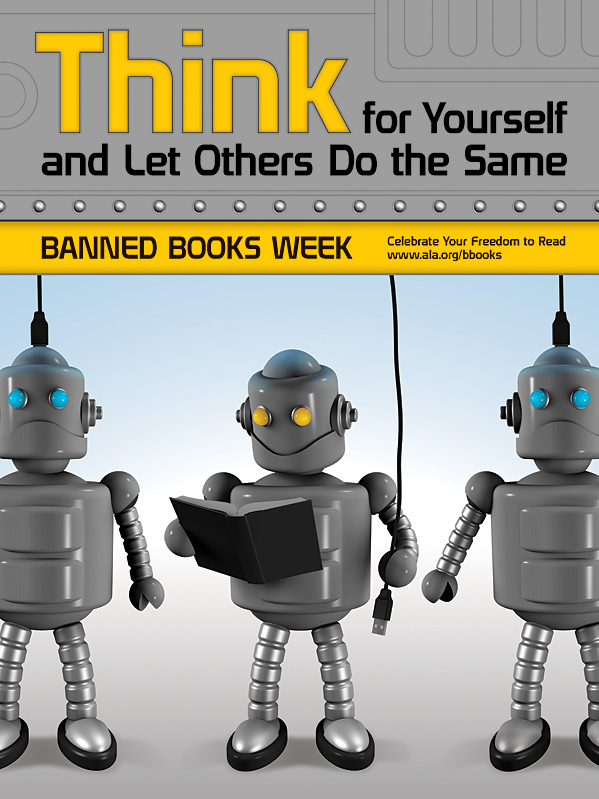
It's Banned Books Week, folks. Click on the link to find ideas and resources to spread the word.
Here are some of the reasons why.
Banned and Challenged Classics
4. To Kill a Mockingbird by Harper Lee
5. The Color Purple by Alice Walker
13. Charlotte's Web by E.B. White
33. The Call of the Wild by Jack London
40. The Lord of the Rings by J.R.R. Tolkien
56. Jazz by Toni Morrison
79. The Maltese Falcon by Dashiell Hammett
81. Wide Sargasso Sea by Jean Rhys
90. The Wind in the Willows by Kenneth Grahame
95. Kim by Rudyard KiplingSafe to say I wouldn't have made it through childhood without some of these books. Go here to read the full list.
Letting someone tell you what you can or can't read is downright unAmerican. There is an Amazon buy link beneath each title. Please do feel free to click on them to buy a copy.
# Permanent link to It’s Banned Books Week 2010!
How the West Was Won
I’m just saying. You know how the West was won? By the federal government, that’s how. The federal government bought Louisiana. The federal government sent Lewis and Clark to Oregon. The federal government sent the US Army to invade California and steal it from Mexico. The federal government sent the US Army to kill every…

I hope this is as close as I ever get to being shot at. This book is that real, that immediate. Junger follows the 173rd Airborne’s Battle Company into the Korengal Valley in Afghanistan, and next to the definition of Hell on Earth in the dictionary? That’s the Korengal Valley. The weather (“Summer grinds on: A hundred degrees every day and tarantulas invading the living quarters to get out of the heat.”) and the terrain (“The last stretch is an absurdly steep climb through the village of Babiyal that the men call “the Stairmaster.””) would have challenged Atilla the Hun, except that Atilla was smart enough not to invade Afghanistan.
As if the weather and the terrain aren’t bad enough, they’re also fighting the culture. “Most Korengalis have never left their village and have almost no understanding of the world beyond the mouth of the valley. That makes it a perfect place in which to base an insurgency dedicated to fighting outsiders. One old man in the valley thought the American soldiers were actually Russians who had simply stayed after the Soviet army pulled out in 1989.”How tough are these guys? “Battle Company is taking the most contact of the battalion, and the battalion is taking the most contact - by far - of any in the U.S. military. Nearly a fifth of the combat experienced by the 70,000 NATO troops in Afghanistan is being fought by the 150 men of Battle Company. Seventy percent of the bombs dropped in Afghanistan are dropped in and around the Korengal Valley.”
Good thing they’re tough, because everyone is shooting at them (“The bullet you dodge will pass you with a distinctive snap. That’s the sound of a small object breaking the sound barrier inches from your head.”). And that’s just when they’re staying “safe” (hah!) behind the wire of Restrepo, an outpost named for a medic who died in combat. “Restrepo was extremely well liked because he was brave under fire and absolutely committed to the men. If you got sick he would take your guard shift; if you were depressed he’d come to your hooch and play guitar.”
This is an on the ground, eyewitness account of men at war, today, this minute, our guys in Afghanistan at work. The prose is clear and sharp and while Junger is inevitably a part of the story, he doesn’t put himself forward too often and he never makes the mistake of thinking anything but the men of Battle Company are the subject.
The larger subject is, of course, war, and Junger does go there later in the book. Armies have a vested interest in figuring out what makes a man fight and fight well, and Junger cities a lot of studies and makes a praiseworthy attempt at explaining why men fight. Testosterone and other hardwired biological stimuli come into it, as you knew they would, but that’s not all there is to it. “The willingness to die for another person is a form of love that even religions fail to inspire, and the experience of it changes a person profoundly. What the Army sociologists, with their clipboards and their questions and their endless metanalyses, slowly came to understand was that courage was love.”
The men of Battle Company love combat, and this book is as close as most people will get to understanding that. “Civilians balk at recognizing that one of the most traumatic things about combat is having to give it up.”
But mostly? You come away from this book thinking, Okay, if it is biologically inevitable that young men are going to go to war? We should pick our fights with more care. These guys are too good to waste.
Junger and photographer Tim Hetherington filmed a documentary based on this same material, Restrepo. Already in my Netflix queue.
# Permanent link to I hope this is as close as I ever get to being shot at.
[youtube http://www.youtube.com/watch?v=zvUdruvbdmI&hl=en_US&fs=1]

Though Not Dead Playlist
I get a lot of comments here at stabenow.com and on Facebook wanting a list of all the books Kate has ever read and all the songs she has ever listened to.* Okay, I heard you. While I was doing the copyedit of Though Not Dead, the eighteenth Kate Shugak novel, I kept track of…

Go here to read librarian Nancy Pearl's most recent feature on NPR talking about good books to read. She's so well-read and so articulate and so enthusiastic, my to-read pile gets longer just listening to her.
And you can follow her on Twitter.
And, glory of glories, she has a blog. And it's got an RSS feed. If, you know, you were into that kind of thing.
She even has her own action figure.
With Nancy on the case, there is absolutely no reason for anyone to be sitting around whining that they don't have anything to read. Yes, you do! Or you do if you listen to Nancy.
# Permanent link to Book lust. You know you’ve got it. So does Nancy Pearl.



Senator Ted Stevens (1923-2010)
It was 1972 and Ted Stevens was coming to the University of Alaska Fairbanks campus to campaign for US Senator. At that time there was some act before Congress involving HUD that had much to do with Alaska. I was a reporter for the Polar Star, the UAF student newspaper, that semester, and my editor…

“Barbie, for men.”
So, I was researching weapons for Kate19, working title Restless in the Grave, and My Guy at the FBI sent me this: He tells me it’s known as “Barbie, for men.”

No King Zone
Happy Fourth of July, everyone!

Good Summer Reads
If I scribbled fast enough while we were on the air, these are all the titles and authors of the books that were mentioned on Coffee Table on KBBI this morning. If I forgot any, or if you want to recommend your own great summer read, post them in the comments below. Alaska books: The…

"...the detective story...is particularly popular in times of unrest, anxiety and uncertainty, when society can be faced with problems which no money, political theories or good intentions seem able to solve or alleviate," she writes. "The classical detective story can work in any age provided murder is regarded as an act which necessitates the discovery of the perpetrator and the cleansing of society of its stain...I see the detective story becoming more firmly rooted in the reality and the uncertainties of the twenty-first century, while still providing that central certainty that even the most intractable problems will in the end be subject to reason."
# Permanent link to P.D. James on the Crime Fiction Case