Author Archives

Dana View All →

Author and founder of Storyknife.org.

A while back I taught a science-fiction-as-lit workshop at the Kenai Public Library. Part of the pre-class assignment was to read H. Beam Piper's Little Fuzzy, watch the Star Trek: The Next Generation episode "The Measure of a Man," and come prepared to discuss the definition of sentience. Everyone had an opinion and the discussion was high, wide and handsome.

Little Fuzzy and the two sequels, Fuzzy Sapiens and Fuzzies and Other People are seminal texts in the science fiction canon, as well as thumpin' good reads. In the far future on the distant planet of Zarathustra, miner Jack Holloway comes home from a hard day's work finding sunstones to discover a visitor in his shower stall, a two-foot high biped covered with gold fur who is unlike any other of the native fauna on Zarathustra. As soon becomes evident Little Fuzzy is sentient as well. This leads to consternation at the Chartered Zarathustra Company, as the Company got their charter on the planet because it was adjudged to hold no sentient life and if Little Fuzzy is found to be sentient the Company will lose their charter. There is mayhem and kidnapping and murder and the Federation Space Navy gets involved and it all winds up in a frontier courtroom in a legal battle over the definition of sentience. Piper's style is so natural and colloquial that it feels like he's telling a story about what's going on next door, with an understated humor that keeps you chuckling all the way through.

The three books have been reprinted in an omnibus edition called The Complete Fuzzy, and you should definitely read them. But wait, there's more.

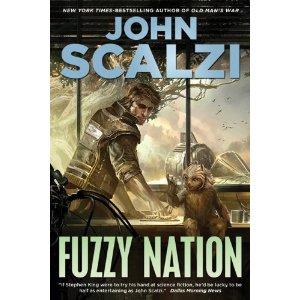
Tomorrow, John Scalzi publishes Fuzzy Nation, what he calls a "reboot" of the first novel. "I took the original plot and characters of Little Fuzzy and wrote an entirely new story from and with them," he writes on his blog. Why? "Because I am a huge fan of the original novel and of H. Beam Piper’s work. It’s a good story and he’s a very good story teller; Little Fuzzy wasn’t nominated for a Hugo on accident, you know. And while the original novel is still, as they say, a “cracking good tale,” I thought there was an opportunity to revisit the story and put a new spin on it to make it approachable to people who had not read the original or did not know about Piper, and also to give fans of the original the fun of seeing some old friends in new settings."

You'll remember Scalzi's Old Man's War? Another thumpin' good read? I can't wait to see what he does with Fuzzies. I'll be getting my copy tomorrow, and I will be unavailable for communication for a while thereafter.


Just for fun, here's the devastating scene from "The Measure of a Man" when Riker damn near sends Data on a one-way trip to the Daystrom Institute, and the following scene where Guinan (Whoppi Goldberg in her best role ever) shows Picard what's really going on. One of the best scenes in TNG, and one of the best sf scenes ever.

And here's the scene where Picard proves indisputably that Data is not a toaster.

[youtube http://www.youtube.com/watch?v=3PMlDidyG_I&w=480&h=390]

# Permanent link to Little Fuzzy Returns

Sex in the Shugak (Park)

[repost from 2008] Okay, let’s have this conversation. Sandy, one of the Danamaniacs managers, just forwarded me an email from a fan which read, in part: “I love the Kate Shugak and Liam Campbell books. I just hope that Ms. Stabenow takes into consideration that some things are best left to a person’s imagination… having…

Read more Sex in the Shugak (Park)

Chugach State Park, Alaska

Photographs by Carl Batreall of Chugach State Park, edited into a video montage. Fabulous. [Some of which I saw originally in this month’s copy of Alaska magazine. You should subscribe, too.] The Chugach State Park is one of the most scenic parks in the world, with a wildlife population that would have had Pliny the…

Read more Chugach State Park, Alaska

The World of Mnemosynea

[reposted from 2008] Take a look at the map of Mnemosynea by clicking on the image. Astute cartophiles (aka map fanatics, such as myself) may find its outline somewhat familiar. Mnemosynea, you may or may not recall, is the world of the Seer and Sword fantasy stories, “Justice is a Two-edged Sword” in Powers of…

Read more The World of Mnemosynea

I'm the last person to recommend yet another book about the American Civil War, one of which seems to be published every five minutes, ad infinitum, ad nauseum. You would think by now that every meaningful thing to be said about the War Between the States has been.

But Adam Goodheart's 1861: The Civil War Awakening might be the exception. For one thing, look at the way he sets events then into context with events now. Money quote from a New York Times article adapted from the book, How Slavery Really Ended in America (emphasis mine):

Earthshaking events are sometimes set in motion by small decisions. Perhaps the most famous example was when Rosa Parks boarded a segregated bus in Montgomery, Ala. More recently, a Tunisian fruit vendor’s refusal to pay a bribe set off a revolution that continues to sweep across the Arab world. But in some ways, the moment most like the flight of fugitive slaves to Fort Monroe came two decades ago, when a minor East German bureaucratic foul-up loosed a tide of liberation across half of Europe. On the evening of Nov. 9, 1989, a tumultuous throng of people pressed against the Berlin Wall at Checkpoint Charlie, in response to an erroneous announcement that the ban on travel to the West would be lifted immediately. The captain in charge of the befuddled East German border guards dialed and redialed headquarters to find some higher-up who could give him definitive orders. None could. He put the phone down and stood still for a moment, pondering. “Perhaps he came to his own decision,” Michael Meyer of Newsweek would write. “Whatever the case, at 11:17 p.m. precisely, he shrugged his shoulders, as if to say, ‘Why not?’ . . . ‘Alles auf!’ he ordered. ‘Open ’em up,’ and the gates swung wide.”

The Iron Curtain did not unravel at that moment, but that night the possibility of cautious, incremental change ceased to exist, if it had ever really existed at all. The wall fell because of those thousands of pressing bodies, and because of that border guard’s shrug.

In the very first months of the Civil War — after Baker, Mallory and Townsend breached their own wall, and Butler shrugged — slavery’s iron curtain began falling all across the South. Lincoln’s secretaries John Hay and John Nicolay, in their biography of the president, would say of the three slaves’ escape, “Out of this incident seems to have grown one of the most sudden and important revolutions in popular thought which took place during the whole war.”

Power to the people. I'm sold.


If you haven't seen it, Ken Burns' Emmy Award-winning series, The Civil War, is still the most comprehensive, most insightful, and most heart-wrenching account of the American Civil War ever made, and it may even be the best documentary ever made. I've seen it all the way through twice, and I could watch it again. Video clips here on the PBS website.

# Permanent link to Power to the People
Only John Scalzi

Because, as John writes on his Whatever blog here, “someone had to do it, and why not me.” John Scalzi, you will remember, wrote the wonderful Old Man’s War, and on May 10th will publish Fuzzy Nation, an update of H. Beam Piper’s classic, Little Fuzzy. I’ll be first in line at the bookstore.

Read more Only John Scalzi